Explore every spot in the city in the most effective ways, and avoid any kind of obstacle or dangerous path. The interactive map will teach all you need to know based on the city you are exploring.

Interactive Map




Enjoy different plans and places with new friends also using the app; or invite your friends and family from other parts of the world to see what you see. Remember to leave some plans to enjoy by yourself.
Connect
Fill the album by tagging the places you visit, the more you explore, the more you learn.
Cherish the experience

BeCome
UX Design for Mixed Realities
BeCome is a Mixed Reality app designed to support newcomers as they adapt to life in a new country. By blending cultural exploration with personal reflection, it helps users navigate their surroundings, evolving while staying connected to who they are. Grounded in research and real stories, BeCome addresses the common struggle of balancing old traditions with new expectations. Through immersive, city-based experiences, it fosters independence, emotional resilience, and a stronger sense of belonging.
2024
By Santiago Viveros
BECOME
UX Design for Mixed Reality
BeCome is a Mixed Reality app that helps newcomers adapt to new environments by blending cultural exploration with personal reflection, encouraging independence, resilience, and belonging through immersive urban experiences.


COME, DISCOVER, ADAPT, BE YOU

BeCOME
UX for Mixed Reality
The MR app that elevates traveling and migration experiences.
Heading 6
Meet you Ai buddy


Buddy will be your assistant, friend and main companion when exploring your new home.
Introduce yourself
Buddy will show you the places everyone must know in your new city, but he wants to make sure you also find places and activities that cultivate your identity and individuality. So tell him a little bit about yourself.

Tell him about your


Get started

To begin with your journey, Buddy will give you a quick tour around your current location. That way you get a glimpse of the city and get familiarized with Become mechanics.
Frame moments

Cherish the experience

Explore


Connect

Mixed realities
This Project is thought to be part of the future where VR is as commonly used as a smart phone.
Big companies are putting much effort and resources into building the dream VR headset. Meta Platforms has spent $46 Billion on the Metaverse Since 2021 (Levy 2024), and Apple recently released Apple Vision in the United States, selling nearly 200,000 despite its elevated price (Thakkar 2024). Companies now lean toward VR and have strong ongoing marketing campaigns to normalize its use. Therefore, as smartphones were once far from existing and took over our lives, VR technologies will be our next reality.
“From desktop to web to phones, From text to photos to video. This is not the end of the line”

Technical functions developed by Cameron Whiting
Mark Zuckerberg
Introduction
Culture shock is a major source of stress for many people relocating abroad, whether for short or long periods. Travelers often face a series of emotional and practical challenges when adjusting to unfamiliar environments, leading to frustration, disorientation, and increasing homesickness. These experiences can significantly impact mental health, sometimes resulting in emotional withdrawal or even hostile reactions toward the new surroundings and their inhabitants.
Despite its difficulties, culture shock also opens the door to meaningful personal growth and cultural exchange. As individuals navigate the complexities of a new culture, they develop resilience, independence, emotional strength, and a broader perspective. For many migrants, the journey leads to a healthy balance, adapting to their new environment while preserving the core values and identity from their homeland.
The Brief
“The number of international students studying in Western Australia totalled 57,339 for the January-March 2024 period. There was a change of 47% compared to the same period last year, and had a 8% share of the overall Australian student numbers.”
Australian Government
How can international students reach the perfect balance between adapting to a new culture and building a strong personal identity?
Culture shock
Who suffers it?
Cultural shock can impact a variety of groups, including immigrants like foreign students, refugees (Dodge 1990), and businesspeople on international assignments (Walton 1990). It can also affect Euro-Americans within their own culture and society, such as in business organizations undergoing restructuring (Knobel 1988), communities undergoing significant technological and social changes (Toffler 1970), and individuals in educational institutions, hospitals, and other establishments.
Causes
The experience of cultural shock and how individuals react to it depend on various factors. These include previous exposure to different cultures, the extent of difference between one's own culture and the new one, the level of preparedness, available social support, and individual psychological traits (Furnham & Bochner 1986). The experience of cultural shock and how individuals react to it depend on various factors. These include previous exposure to different cultures, the extent of difference between one's own culture and the new one, the level of preparedness, available social support, and individual psychological traits (Furnham & Bochner 1986).
According to Winkelman (1994) Cultural shock is partly caused by cognitive overload and behavioral inadequacies. Since effective intercultural interaction depends on understanding and adapting behavior, cultural shock is best addressed through a social learning approach. This involves integrating new attitudes and cognitive information into behavioral changes. According to Winkelman (1994) Cultural shock is partly caused by cognitive overload and behavioral inadequacies. Since effective intercultural interaction depends on understanding and adapting behavior, cultural shock is best addressed through a social learning approach. This involves integrating new attitudes and cognitive information into behavioral changes.
When people react to cultural differences that affect their performance, it can lead to psychological crises or social dysfunctions. These stress responses can have both psychological and physiological effects, including physical, emotional, interpersonal, cognitive, and social aspects. Changes in sociocultural relations, cognitive fatigue, role stress, and identity loss can also result from these interconnected aspects of culture shock. (Winkelman 1994).
Stress reactions
Exposure to a different environment can induce stress and physiological responses, which may interfere with the body's pituitary-adrenal activity (Levine, Goldman and Cooper 1972 as cited by Taft 1977). Stress can elicit various reactions, affecting the immune system and enhancing susceptibility to illnesses (Guyton 1986). Adjusting to a new culture can generate stress due to physiological and psychological factors, influencing the body's responses and increasing feelings of stress, anxiety, and depression. This can lead to heightened concerns about illness and psychosomatic physical ailments due to stress-related declines in immune system function.
Cognitive fatigue
One of the main challenges of culture shock is cognitive fatigue, which occurs when there is an overwhelming amount of new information to process. Adapting to a new culture requires a conscious effort to understand things that were previously processed automatically. This shift from automatic to conscious processing can be tiring and lead to mental and emotional exhaustion, resulting in symptoms such as tension headaches and a desire to avoid social interactions, especially as the amount of new information continues to accumulate (Guthrie 1975).
Role shock
Entering a new culture can lead to "role shock" as familiar social roles are replaced with unfamiliar ones, impacting well-being and self-concept. This can result in uncertainty about one's social position, loss of normal social relationships, and adoption of conflicting roles (Byrnes 1966).
Culture shock phases
The honeymoon
The first phase is the typical experience of people who visit other cultures for honeymoons, vacations, or brief business trips. During this phase, they are usually very interested and excited, feeling euphoric and finding it hard to sleep due to positive expectations and idealizations about the new culture. Although there may be some anxiety and stress, these are generally interpreted positively. This is the opposite of what we think of as cultural shock. This is because honeymooners, vacationers, and business people tend to have experiences that are largely limited to institutions such as hotels, resorts, businesses, and airports, which isolate them from having to deal with the local culture in a significant way and on its terms.
The crisis
The shift from the initial excitement of a new experience to a challenging phase varies from person to person. A crisis can arise The shift from the initial excitement of a new experience to a challenging phase varies from person to person. A crisis can arise shortly after arrival, leading to increasing difficulties and negative feelings. Symptoms of culture shock include frustration, irritability, preoccupation with cleanliness, disappointment, and a sense of helplessness or isolation. Physical and emotional signs like tiredness and sadness can also appear. Criticism of the new culture becomes more common, language learning may slow down, and the longing to go back home becomes stronger. Coping strategies involve trying to go back to familiar cultural practices.
The adjustment
The third phase includes learning how to effectively adapt to a new culture. Overcoming cultural shock demands making acceptable adjustments. There are various phases of adjustment, and some individuals may choose to avoid or isolate themselves instead of adapting. Effective functioning requires adjustment, adaptation, the development of problem-solving skills, and a positive embrace of the new culture. Negative reactions decrease as understanding and appreciation of the new culture increase. The process of adjustment is gradual and involves repeated crises and readjustments.
The adaptation
The fourth phase is reached when stable adjustments are made, resulting in successful problem-solving and the management of the new culture. Depending on individual traits and objectives, there are various options for adaptation. While complete assimilation may be difficult, cultural adaptation promotes acculturation and substantial personal development, nurturing a bicultural identity. It is important to recognize that effective adaptation brings about change, leading to assimilating new cultural aspects into one's self-perception. Reaching this stage requires a positive response to cultural shock and implementing effective adaptation methods.
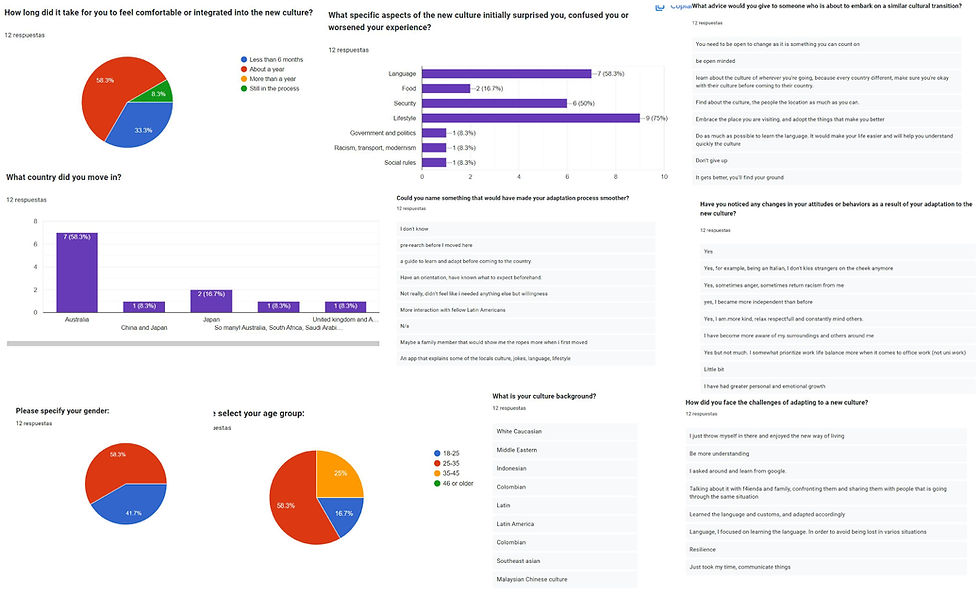
Surveys
Based on key aspects of previous research on culture shock, I conducted quantitative research to understand different perspectives on how individuals experience and manage the adaptation process. This questionnaire was shared primarily with international students from diverse backgrounds living in Western Australia, although some international students living in other countries also participated.

Ideation map
I found many interesting VR app references aimed at helping travelers, each offering valuable features. However, I didn’t want my project to become a mere collection of functionalities. Instead, I aimed to craft a cohesive, engaging, and enjoyable experience. I also chose to focus specifically on international students and their unique needs.
At the same time, I was careful not to present the app as a last resort for those struggling, but rather as a first-choice tool for anyone seeking a meaningful and enriching experience abroad. To develop this concept, I gathered my insights and connected the dots to shape a clear and purposeful vision.

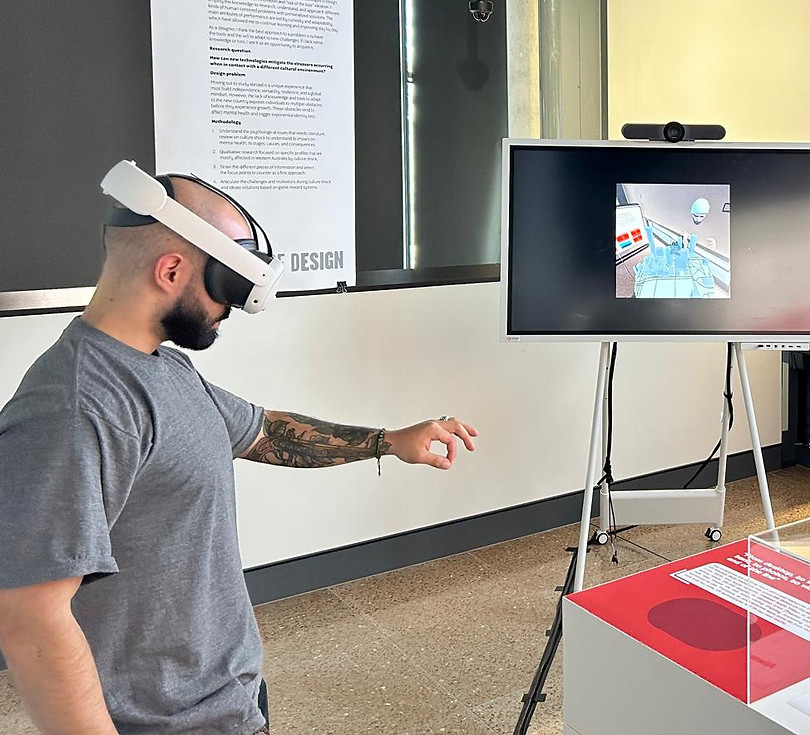
Exhibition


Special thanks to:
Cameron Whiting
Technical Officer
References
Berg Kalvaro, O. 1960. 'Culture Shock: Adjustment to New Cultural Environment.' Practical Anthropology.
Byrnes, Francis C. 1966. "Role Shock: An Occupational Hazard of American Technical Assistants Abroad." The Annals of the American Academy of Political and Social Science 368 (1): 95-108.
Dodge, Susan. 1990. "Culture Shock and Alienation Remain Problems for Many Foreign Students on Us Campuses." Chronicle of Higher Education 36 (25).
Guyton, Arthur CMD. 2006. Text Book of Medical Physiology. China.
Norman, Donald A, and Pieter Jan Stappers. 2015. "Designx: Complex Sociotechnical Systems." She Ji: The Journal of Design, Economics, and Innovation 1 (2): 83-106.
Knobel, L. 1988. "Hewlett-Packard’s Cultural Shock." Management Today: 101-106.
Taft, R. 1977. 'Coping with Unfamiliar Cultures: Studies in Cross-Cultural Psychology. 1, 121-153.' London: Academic Press.
Toffler, Alvin. 2021. Future Shock. Random House.
Walton, Sally J. 1990. "Stress Management Training for Overseas Effectiveness." International Journal of Intercultural Relations 14 (4): 507-527.
Ward, Colleen, Stephen Bochner, and Adrian Furnham. 2020. Psychology Culture Shock. Routledge.
Winkelman, Michael. 1994. "Cultural Shock and Adaptation." Journal of Counseling & Development 73 (2): 121-126.